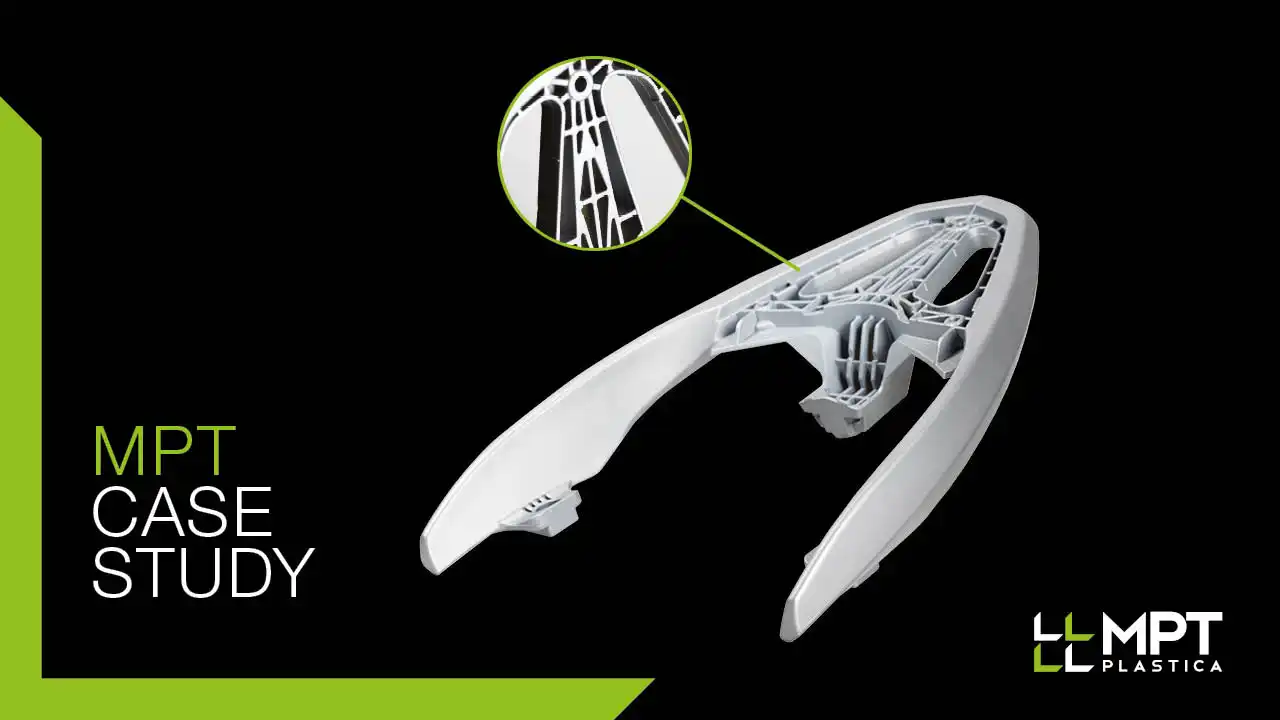
Gas-Assisted Injection Molding: the technology you don’t see, but that solves visible defects.
Gas-assisted injection molding is a technology designed to control melt behavior, reduce weight without compromising strength, stabilize geometry, and prevent defects before they appear. It’s the go-to option for applications where “conventional” injection molding is not enough.
We’re talking about class A visible parts, metal replacement, and dimensionally critical components designed for long service life. Complex shapes, non-uniform walls, and thick sections can generate internal shrinkage, sink marks, or warpage, issues that may remain hidden until the part reaches the assembly line or a paint shop.
A common real-world case: the license plate bracket arm
The license plate bracket arm is a very common component with a challenging geometry, because it requires:
• a structure that is rigid yet thin,
• significant thickness in localized areas,
• aesthetic constraints on the painted surface.
The main risks are localized shrinkage, visible deformation, and fit/assembly issues during installation.
For the license plate bracket arm of a major player in the sector, MPT specified gas-assisted injection molding already at the design stage. The objective was to hollow out the internal core while maintaining shape, reduce residual stresses, and improve dimensional stability, while also matching the selected material: PARA GF50 (IXEF 1025), which provides high mechanical strength together with a surface finish suitable for direct painting.
The result is a stable, assembly-ready part, with aesthetic quality that remains fully repeatable across subsequent production batches.
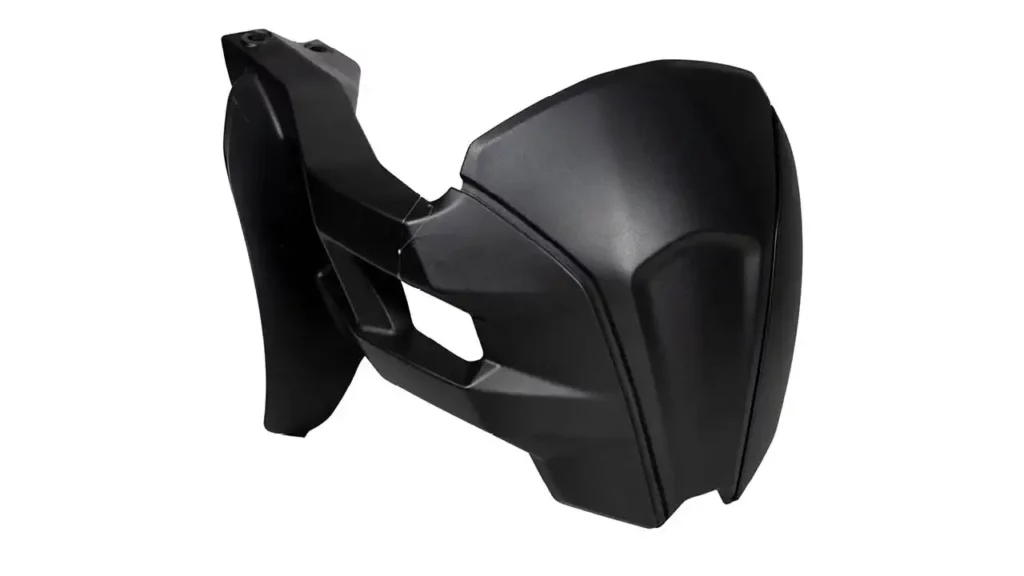
Why and when to choose gas-assisted injection molding
In many projects, you can’t simply redesign the geometry to eliminate thick sections, because that would lead to:
• reduced stiffness or mechanical strength;
• compromised assembly or interface stability;
• changes to the external shape driven by aesthetic or aerodynamic constraints.
Gas-assisted injection molding acts on material behavior, not on the part’s external design, reducing shrinkage and internal stresses without changing the outside geometry and <b
The process involves injecting a high-pressure inert gas (typically nitrogen) into the part immediately after melt injection. This makes it possible to:
• core out central sections without reducing mechanical performance,
• balance material distribution, reducing deformation and warpage,
• pack the walls against the mold, achieving cleaner surface quality.
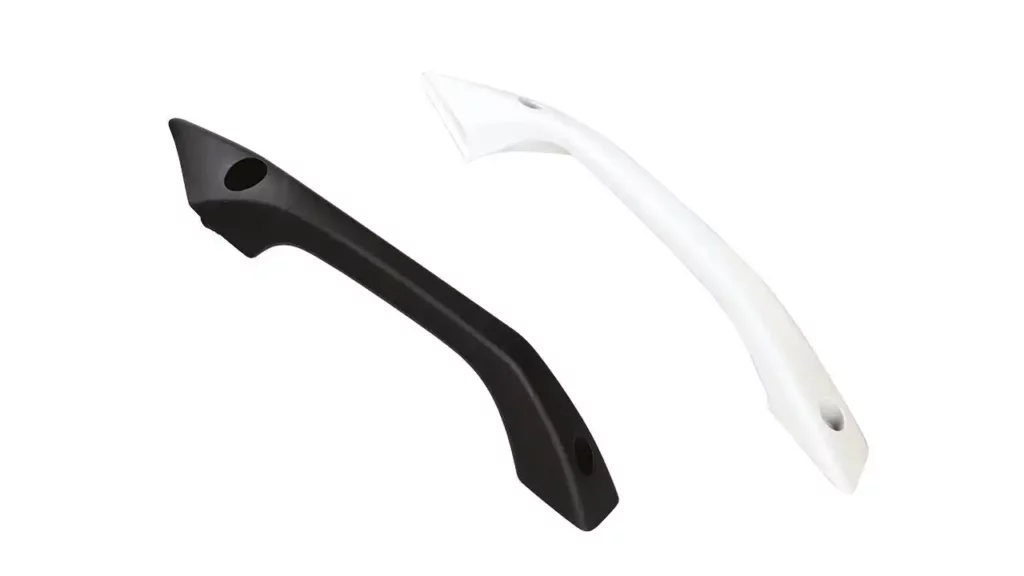
Industries that benefit from gas-assisted molding precision
Automotive
Visible structural/aesthetic parts and metal replacement: complex components with thick sections, engineered to withstand mechanical loads, often historically made in die-cast aluminum or machined. Gas-assisted molding reduces weight and shrinkage and improves surface quality.
Technical furniture and industrial design
Visible and functional parts: hollow seats, panels, integrated load-bearing structures. Gas assistance delivers more uniform surfaces, reducing sink marks and internal stress.
Appliances and electronics
Aesthetic housings, shells, and complex enclosures. Gas-assisted molding enables more stable geometries, simpler assemblies, and fewer secondary operations or rework.
But the value of this design choice is cross-industry:
• Less weight and less material, without compromising strength,
• Less warpage and fewer visible sink marks, even with non-uniform walls,
• Higher aesthetic quality, with consistent finishes,
• Fewer rework steps and fewer additional tests,
• Better repeatability from batch to batch.
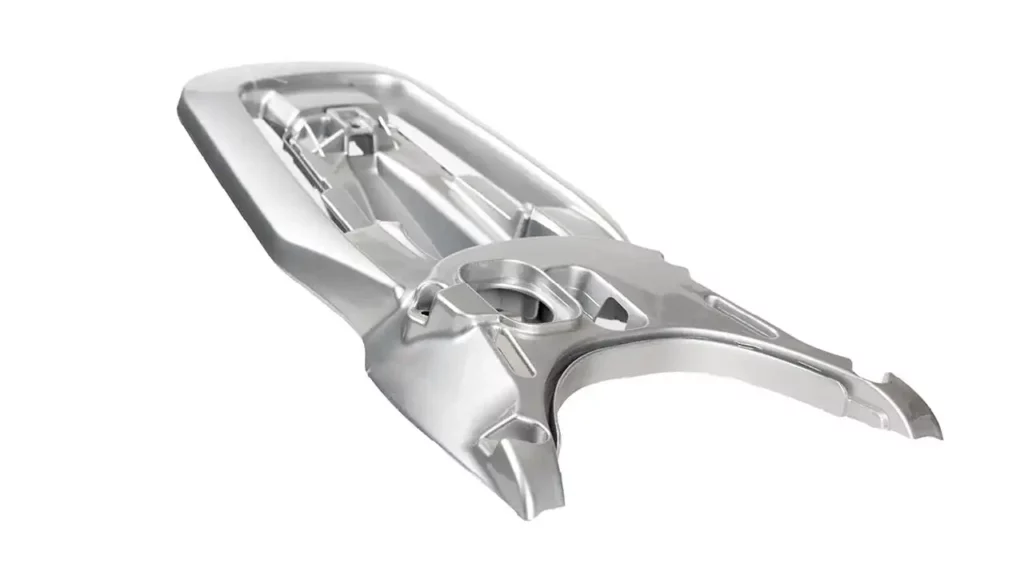
At MPT, gas-assisted injection molding is a strategic asset
Quality isn’t only the final outcome. It’s consistency that starts much earlier.
At MPT, gas-assisted injection molding is an integrated engineering response, starting from co-design, built on hands-on experience in sectors where every surface is not only aesthetic, but an active part of performance.
This is where the “invisible technology” of gas assistance becomes visibly effective: it anticipates what will happen during assembly, finishing, and real-world use throughout the production chain.
If you’re designing complex plastic components, such as visible parts or dimensionally critical geometries, this technology can make the difference before the problem shows up.
Talk to us: https://www.mptsrl.it/en/contact-us/