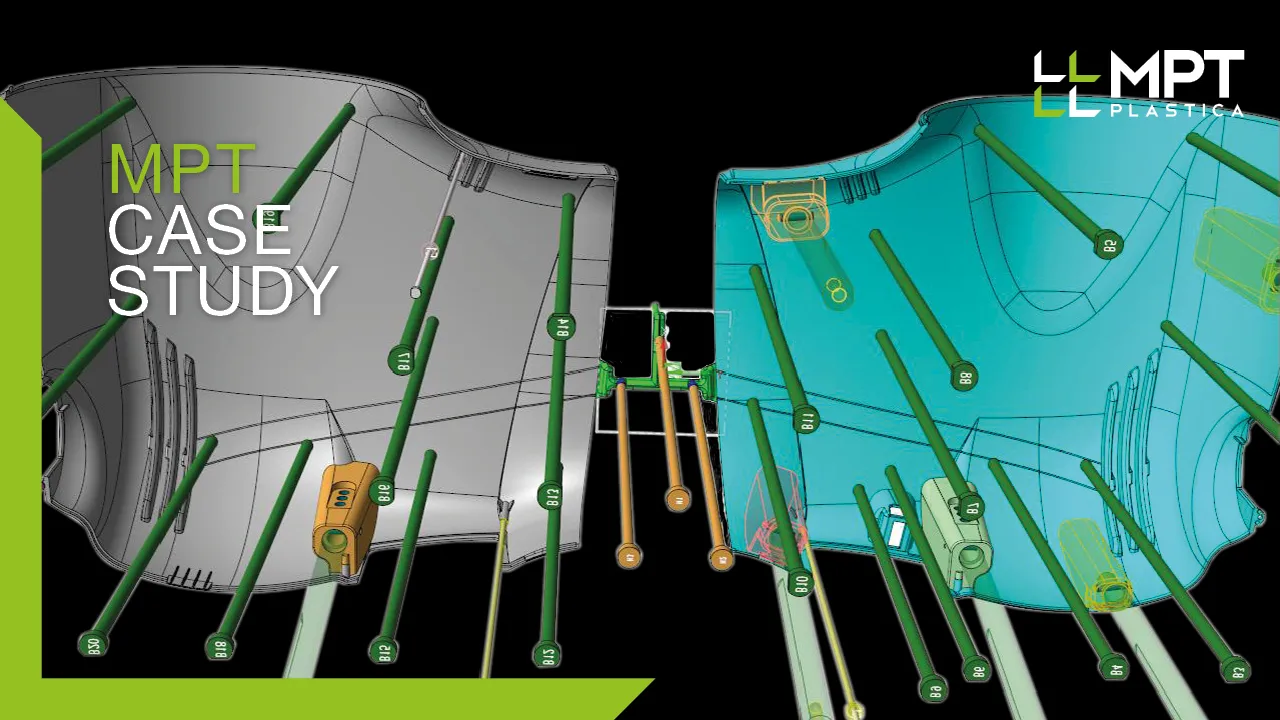
Seeing perfection in an ophthalmic system: how to mold a medical enclosure with a Class A surface
Seven components in flame-retardant PC+ABS, from the 313 mm shell to the 14 mm actuator: the inspection criterion that precedes the mold, the co-design that prevents the defect, and the entire process that eliminates carbon inclusions and color drift.
Anyone developing a diagnostic device for the ophthalmic sector assigns the enclosure two requirements that rarely coexist without friction. The first is regulatory: the enclosure of electromedical equipment requires a flame-retardant (self-extinguishing) material with a documented flammability rating.
The second is perceptual: the instrument is used every day by vision-care professionals, at close range, in illuminated clinical environments. The external surface is the first piece of information the device gives about itself.
This article retraces the path of a real project — feasibility analysis, mold design, molding process, quality control: the complete set of covers for an ophthalmic measurement instrument, a Class II medical device, for a leading OEM in the sector.
The specification: inspection comes before design
Not just function. Together with the 3D models, the customer supplies the document that defines the cosmetic acceptance criteria: this is the standard against which every batch will be inspected, mapped directly onto the 2D drawings. Every surface of every cover has a declared aesthetic category: always-visible grained, exposed, hidden.
For Category A surfaces — those observed directly during use — the inspection is codified in detail: observation at 25 cm for 15 seconds, cool white lighting between 800 and 1,700 lux, an inspector with 10/10 visual acuity, no magnification, and a viewing direction identical to that of the end user.
In this specific case, we had thirteen codified defect types — from shade variations to foreign particles, from surface sink marks to unexpected mold marks — and in Category A none of them is acceptable. Every deviation from the criteria must be formally justified.
For the manufacturer, the message is clear: aesthetic conformity is built upstream of everything, in the mold design and in the process. The next two phases show how.
Co-design: the Class A surface is engineered into the mold
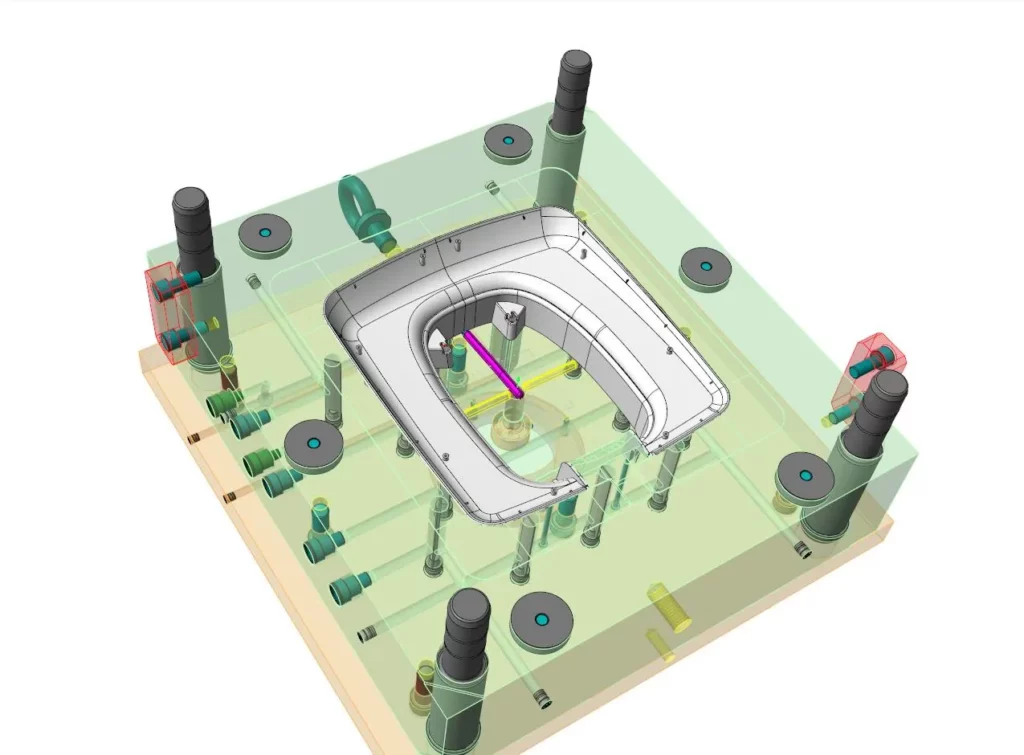
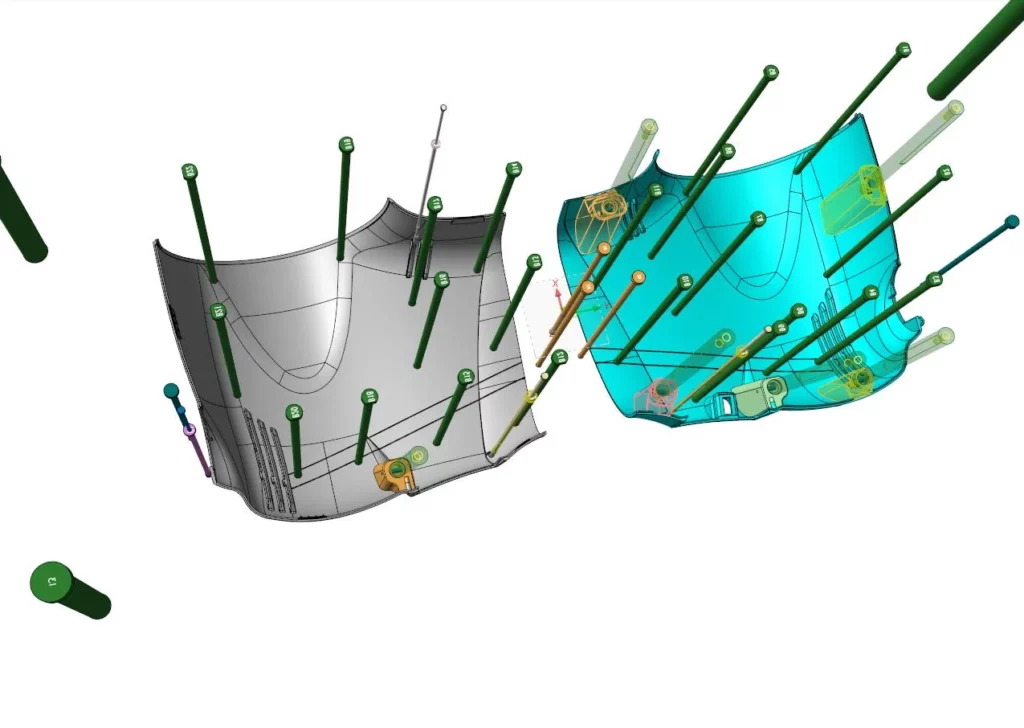
Before building the mold, MPT runs a documented feasibility analysis on the customer’s 3D data — draft angles, wall thicknesses, risk areas — and returns it to the customer as the basis for a technical discussion: proposal, response, decision, tracked point by point.
On this project the discussion covered four areas:
- Wall thicknesses. The analysis mapped the critical sections of each component: on the moving-base cover, with average walls of 2.8 mm, section reductions on the visible side and increases up to 3.7 mm at the snap-fit features; on the head shells, internal ribs with bases up to 3.2 mm on 3 mm walls, and geometries that generate visible sink marks on the aesthetic side. The agreed countermeasures: ribs reduced toward 0.9–1 mm, one wall taken from 3 to 2 mm, and gradual wall-thickness reductions on internal features wherever the geometry allowed.
- Draft angles. The mold’s mating surfaces were set to at least 3°–5° to prevent galling and flash, and the zones tending toward zero draft — particularly the mating openings between the two shells — were declared to the customer as a long-term flash risk.
Where the 3D geometry was fixed, the residual risk remained documented and knowingly accepted by both parties. Transparency about what the design leaves open is as much a part of the method as the optimizations that succeed. - Graining. The texture is decided during mold design: a grained finish requires adequate draft angles, and zones without draft stay smooth out of geometric necessity. The analysis indicated to the customer which surfaces could be grained and which could not, and where graining was ruled out, the drawing incorporated the requirement for a smooth finish.

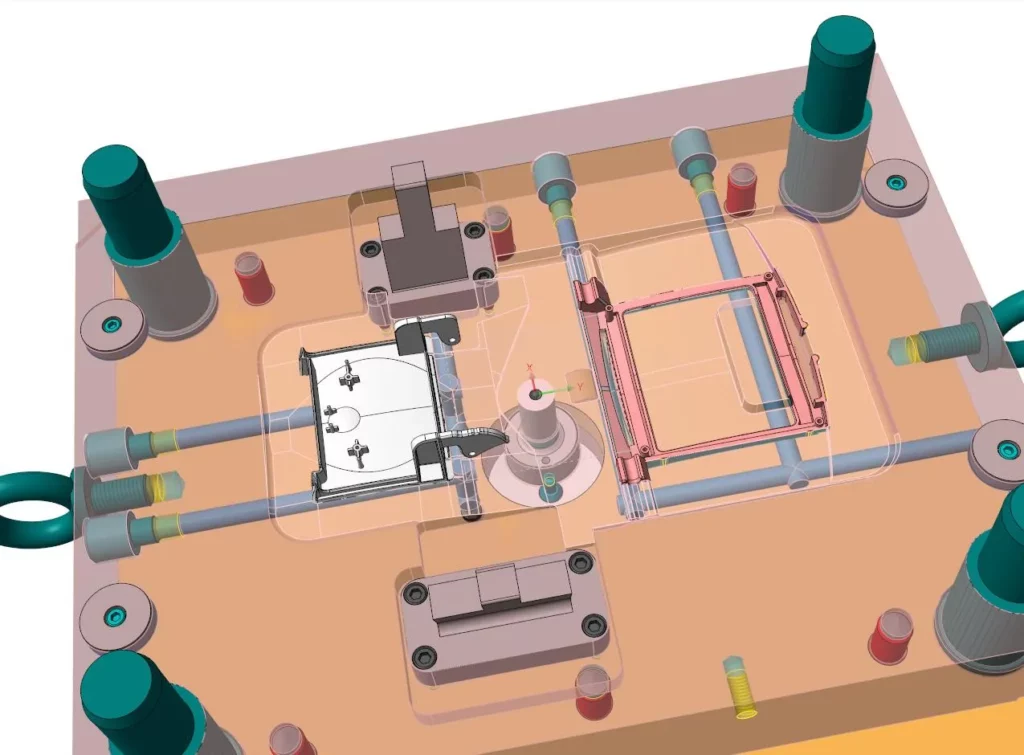
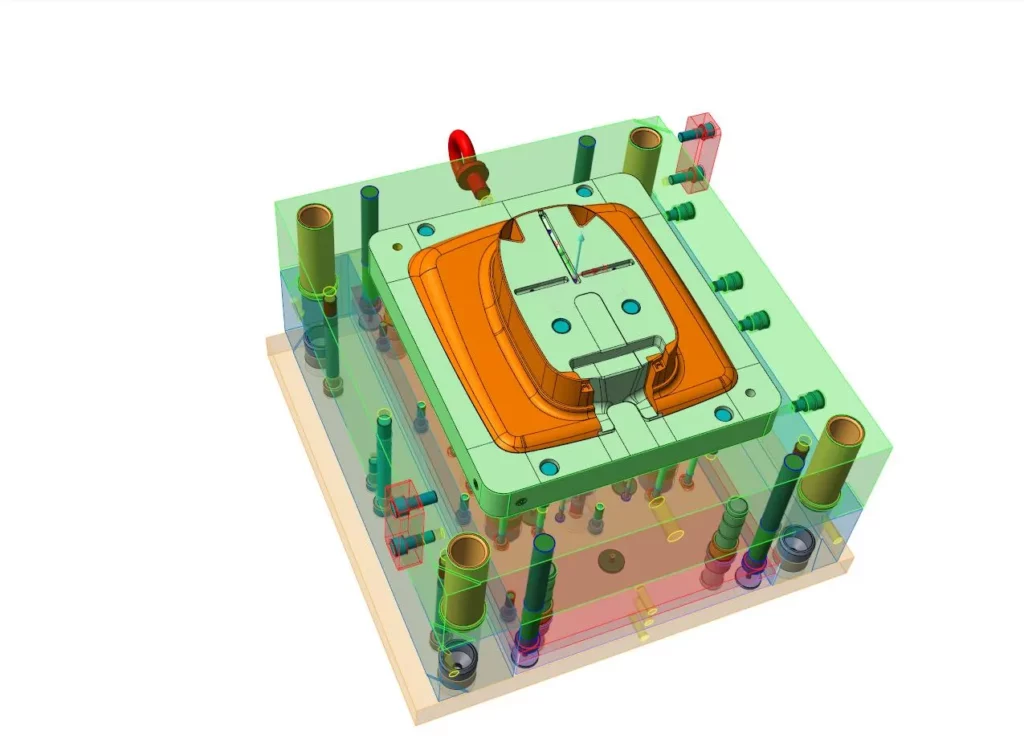
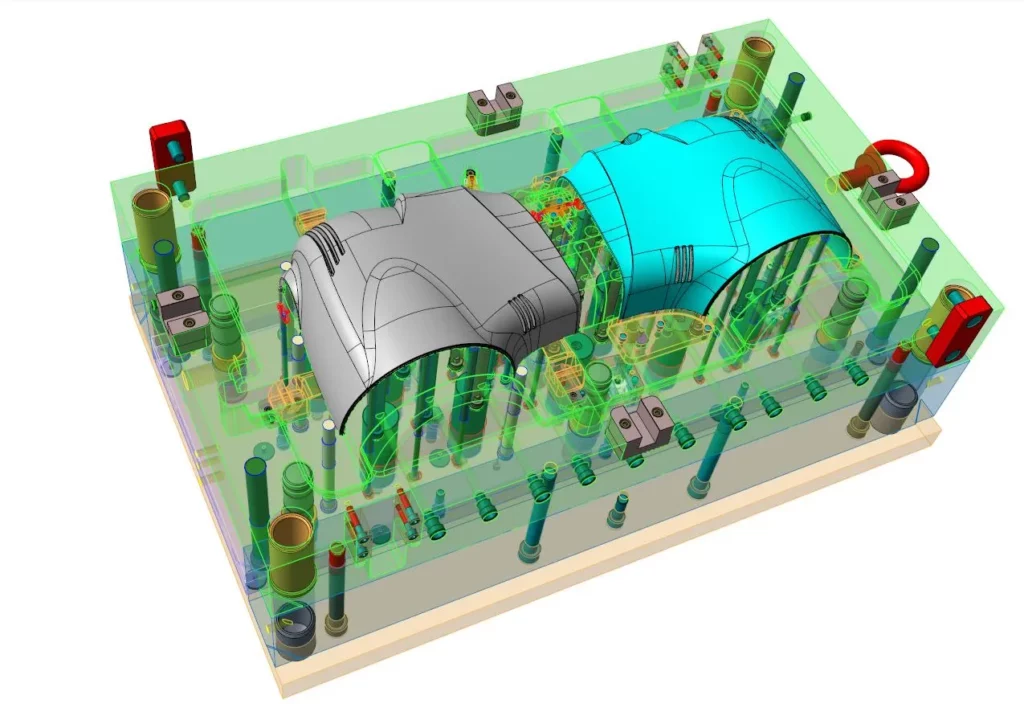
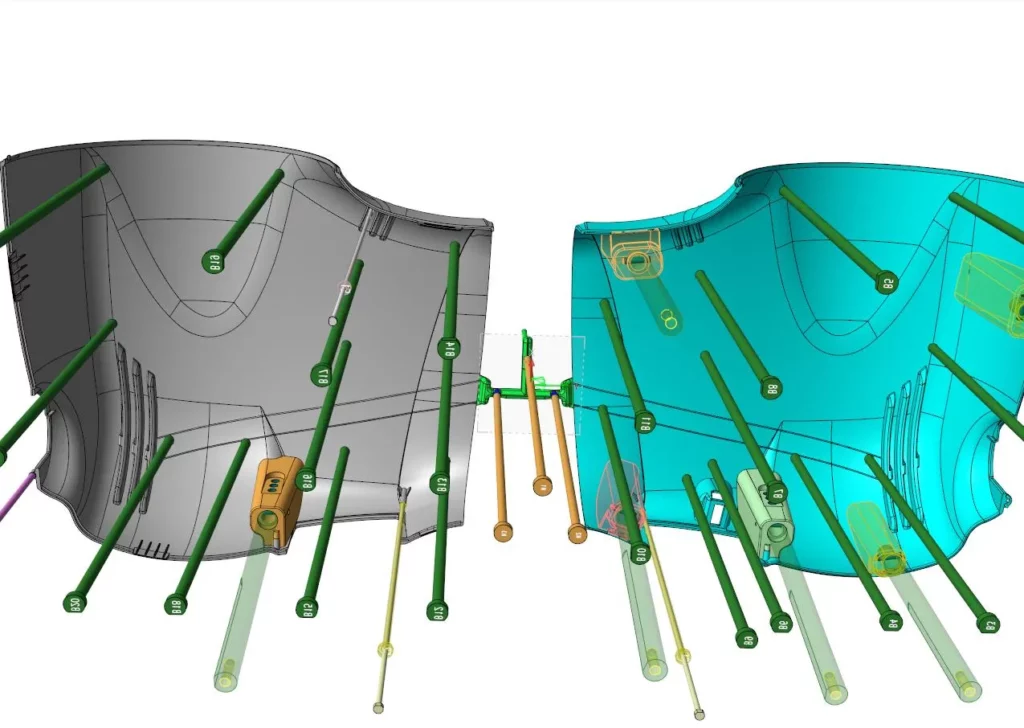
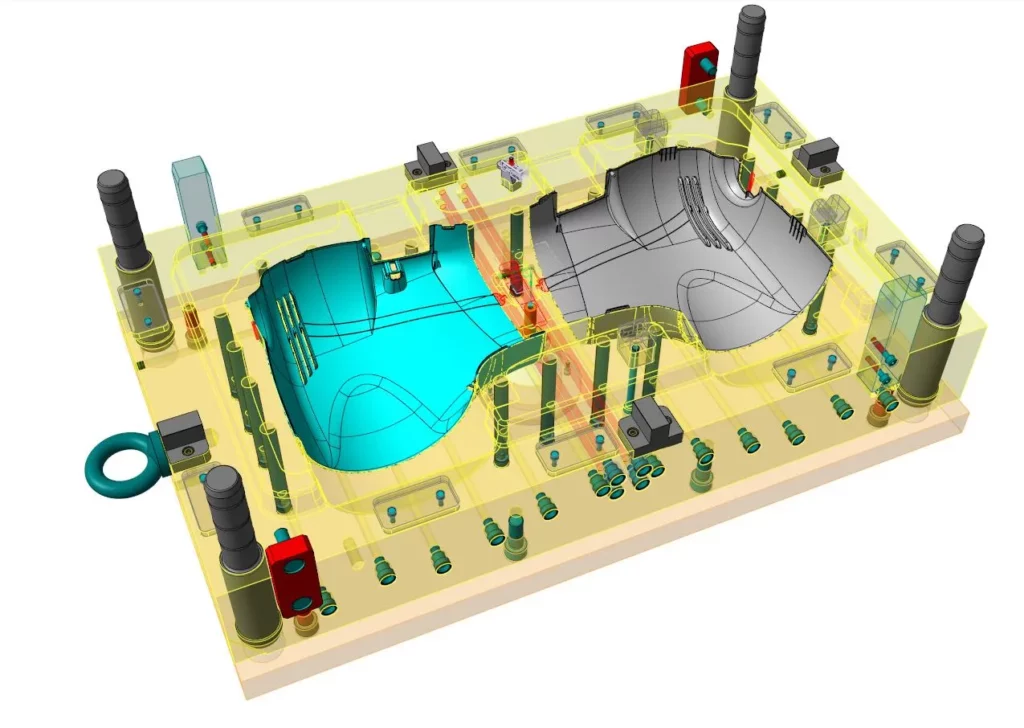
- Aesthetic-functional details. On the snap hooks between the two shells the customer set a firm constraint — no marks from mold movements allowed — and the mold architecture was laid out accordingly, drawing on experience with previous versions of the same instrument. For the base-cover snaps, the narrow, deep mold sections originally planned would have suffered localized overheating of the steel, with deformation on the plastic: the proposed solution shifts the release onto movable inserts (slides), an approach already proven on earlier components. On the button, the gate was moved toward the rear of the hook, where the mark stays flat and out of sight; the mandatory markings — date stamp, part code, recycling symbol — were positioned around the ejectors and cooling.
The process: carbon inclusions, color stability, thermal degradation
With the mold right, conformity is a match played entirely in production. On a white flame-retardant PC+ABS blend, the process faces three specific adversaries.
- Carbon inclusions. Flame-retardant polymers have a narrower processing window than standard grades: this material is processed between 240 and 280°C, with thermal decomposition beginning around 300°C. The margin between a correct process and degradation is only a few tens of degrees. Localized overheating, excessive melt residence time in the barrel, and stagnation in dead zones generate carbonized material, which breaks loose and surfaces as a dark inclusion. On a white Category A cover, prevention is the only route: a barrel temperature profile managed zone by zone, disciplined cycle times, and systematic purging at production changeovers.
- Color stability. The flame-retardant package is the most thermally sensitive component of the blend: non-uniform thermal management produces streaks and color drift even before inclusions appear. Add to this the material’s hygroscopicity: residual moisture must stay below 0.02% before molding — drying at 85°C for 3–4 hours in a dry-air (desiccant) dryer — because above that threshold surface streaking and hydrolytic degradation of the polymer appear.
- Mold temperature. The mold must be held uniformly between 60 and 80°C: lower temperatures shorten the cycle but degrade the surface finish and increase internal stresses and post-molding shrinkage. The trade-off between throughput and surface quality is declared when the process is defined. Completing the picture is shear control, with a screw circumferential speed between 0.1 and 0.3 m/s, to avoid mechanical degradation of the material.
A result that holds, batch after batch
The set spans two orders of magnitude in size with the same material, the same cosmetic category on the visible surfaces, and the same acceptance-inspection method. The Class A surface is a property of the process, and it applies to every component that comes out of it, from the 313 mm cover to the 14 mm actuator.
In the medical field, however, a supplier’s qualification is not defined — as in many sectors — on the first batch alone: it is decided on consistency. That is why the process is overseen by three systems that work on repeatability.
- Instrumental color control: color uniformity between batches is verified with a spectrophotometer — a measured, comparable value over time. On a medical white, color drift from one supply to the next is among the most insidious defects, because it only emerges when the components are placed side by side.
- Digitalized traceability from raw material to finished product: if a parameter shifts, the traceback from the component to the material lot, the machine, and the process conditions is documented. In the medical sector this reconstruction capability is a quality-system requirement before it is a refined problem-solving tool.
- Molding process stability: on productions with high aesthetic criticality, presses with electronically controlled axes keep the injection parameters repeatable cycle after cycle, reducing the variability that, on a material with a narrow thermal window, translates directly into a surface defect.
How to evaluate a molding supplier for the medical sector: three criteria
The experience of this project translates into three concrete questions for anyone looking for a supplier:
- Does it perform a documented DFM analysis on the 3D data before building the mold, with draft angles, wall thicknesses, and risk areas mapped?
- Does it declare in writing the residual risks where the design does not eliminate them?
- How does it verify aesthetic conformity — with what instruments, what method, and what frequency?
The answers to these three questions, more than any sales pitch, anticipate how the first incoming-inspection will go.
If you are designing a device with enclosures to an aesthetic specification, MPT performs the entire process described in this article: DFM analysis on the 3D data, mold built in its in-house tool shop, molding of flame-retardant polymers, and instrumental color control.
For a feasibility assessment on a drawing or 3D model, visit our section dedicated to co-design: https://www.mptsrl.it/codesign/